Why timber cladding should be your go-to material for commercial buildings
If you could select a cladding material that combines sustainability, aesthetics, and long-lasting performance, wouldn’t you? As architects place greater emphasis on eco-friendly practices, timber cladding has become a go-to solution for commercial buildings. This versatile material not only adds visual appeal but also provides a number of benefits, making it a favourite among architects and designers. In this blog, we’ll explore why timber cladding is the smart choice for commercial projects, focusing on its sustainability, speed of construction, energy efficiency, and more.

Sustainability and environmental impact
Timber is one of the most sustainable building materials available, thanks to its renewable nature, low embodied energy, and impressive carbon capture properties. CO₂ emissions are a major contributor to global warming, and timber plays a crucial role in combating this issue. As trees grow, they capture CO₂ from the atmosphere, which is then locked in and stored indefinitely in the wood. Timber’s renewable qualities also offer a solution to material shortages, supporting a circular economy by enabling the reuse and repurposing of materials.
By choosing timber for commercial buildings, developers not only reduce the carbon footprint through the CO₂ stored in the wood but also displace emissions by avoiding the use of energy-intensive materials like concrete and steel. Timber takes less energy to produce than any other building material. Our Scotlarch® is among the lowest embodied carbon materials available in the UK. Take a look at Dundreggan Rewilding Centre, a world-first in our native Scottish Highlands, designed by Threesixty Architecture. Beautifully timber-clad in Scotlarch®, the main aim was to prioritise local and low embodied carbon materials to ensure a responsible and sustainable building.
Versatility in design
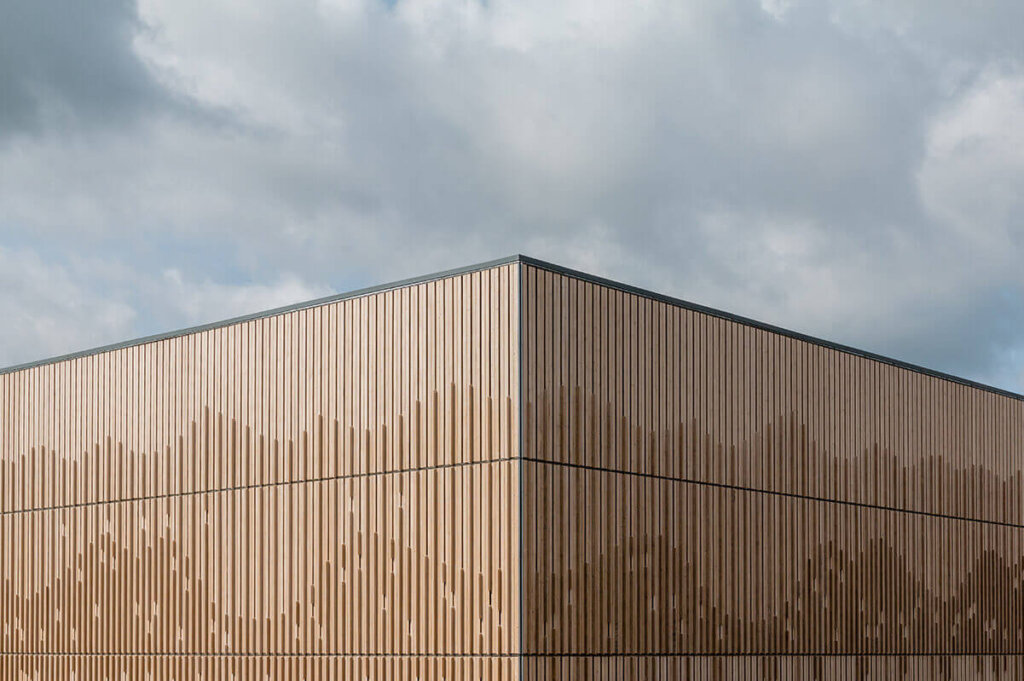
Timber cladding offers aesthetic flexibility that other materials can’t meet. Whether your project requires a modern, minimalist design or a traditional, natural look, timber can adapt to suit various architectural styles.
For public and commercial spaces, where first impressions are critical, the visual appeal of timber cladding is a powerful tool. The natural grains, tones, and textures of timber lend warmth and authenticity, creating an inviting atmosphere for office buildings, retail spaces, and public facilities alike.
Russwood timber cladding is available in a variety of species and finishes, making it easy to find the right fit for any project. Whether it’s Thermopine®, with its prominent figuring and the option of many different coatings, or the distinct look of the Lunawood Collection with its warmth and butterfly knots, timber can enhance any architectural vision.


Timber as a building material
Timber is more than just a cladding option – it can be used structurally as well. A common misconception is that timber lacks the strength to compete with materials like steel and concrete, especially in large-scale commercial buildings. However, advancements in engineered structural timber, such as cross-laminated timber (CLT) and glulam, have transformed our understanding of timber’s potential in construction.
These innovations make structural timber a viable option for multi-story buildings and large commercial structures. CLT, for instance, offers strength comparable to steel, while still being significantly lighter. Glulam, which is engineered by bonding layers of wood together, is incredibly strong and can be used for beams, columns, and arches. This gives architects freedom to design larger spaces without compromising on structural integrity. On public spaces, damaged boards can easily be replaced with minimal impact on the rest of the build, making it an easily repairable material too.
Another benefit of cross-laminated timber (CLT) panels is that they are prefabricated, which significantly speeds up construction timelines. Prefabrication allows for precise, off-site production, reducing on-site labour and construction waste. For commercial projects, this means faster turnaround times and cost savings.
Whether used in commercial offices or multi-functional public spaces, the use of CLT can streamline the entire construction process. Russwood offers a range of high-quality timber solutions allowing for efficient and sustainable building practices that meet the demands of modern construction.
Energy efficiency
In addition to its structural benefits, timber cladding is also an excellent insulator. Its natural insulation properties make it an energy-efficient choice for commercial buildings, reducing the need for artificial heating and cooling systems. This translates to lower energy bills and a reduced environmental impact over the building’s lifetime.
For commercial spaces that need to balance functionality and cost-effectiveness, timber cladding offers an attractive solution. Its energy-saving qualities ensure that buildings are more comfortable for occupants while helping companies achieve sustainability targets.
Health and well-being benefits
Timber cladding can also be used internally, offering benefits that go beyond sustainability and energy efficiency. Studies show that timber interiors promote mental well-being, reduce stress, and improve indoor air quality. This makes timber cladding particularly valuable in commercial settings like offices, schools, and healthcare facilities, where employee and occupant well-being is a top priority.
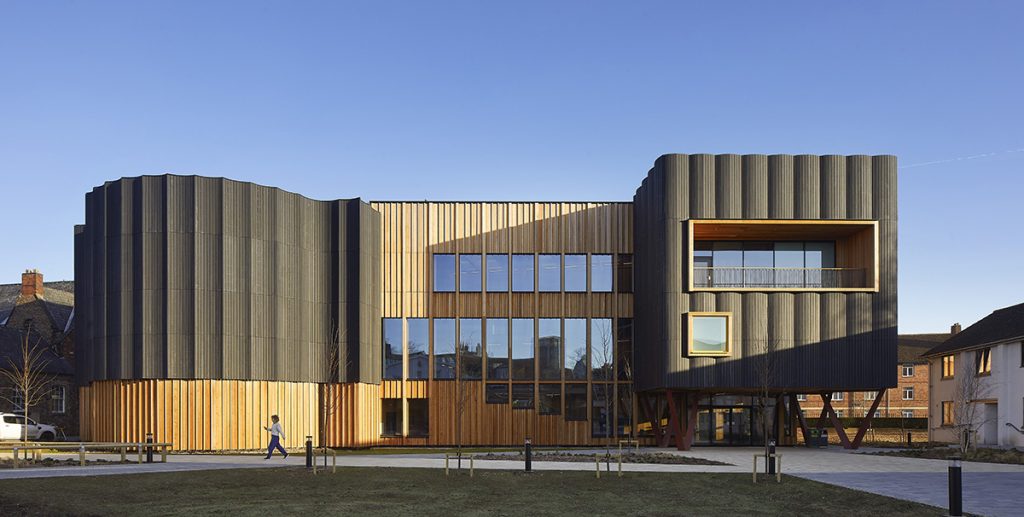
The warm and natural appearance of timber can have a calming effect on people, creating environments that promote productivity and relaxation. The connection to nature, often referred to as biophilic design, has been proven to boost mood and mental health, making timber cladding an ideal material for buildings that prioritise the well-being of their occupants. Award-winning project, York St John University Creative Campus by Tate+Co utilises Russwood timber cladding outside and in, specially constructed with a combination of CLT and glulam from Glulam Solutions. The project was also treated with Burnblock Fire Retardant, and ticked all the boxes for a warm, collaborative, yet striking space for students to enjoy.
Fire performance
A key concern that often arises with timber is fire safety. However, when treated with a fire retardant, the Reaction to Fire (Euroclass) rating for timber cladding can be on par with many other commonly used building materials. Fire retardant treated timber cladding, such as Burnblock-treated Thermopine® is designed to meet rigorous fire safety standards, and can now be paired with SiOO:X coating. This option allows architects and developers to take full advantage of timber’s aesthetic and environmental benefits without compromising on safety. This is especially critical in large-scale commercial projects, where fire safety is a non-negotiable.
With Russwood’s commitment to quality and sustainability, timber cladding provides a smart choice for commercial spaces looking to embrace both aesthetics and performance.
