Fire performance requirements for timber cladding: a specifier’s guide

In today’s construction landscape, understanding fire performance is crucial, especially when working with materials like timber cladding. This guide, by Ross McCormack, our Architectural Liaison Technician, is to help specifiers navigate the complex nature of fire performance requirements.
Whether you’re selecting materials, planning installation, or ensuring compliance with regulations, this guide will walk you through the key considerations and standards that must be met when using timber cladding. By the end, you’ll be equipped with the knowledge needed to make informed decisions that prioritise safety and aesthetic value in your projects.

Fire regulations in a nutshell
Fire performance in buildings can be measured in two ways; Reaction to Fire and Fire Resistance.
Fire Resistance is the more commonly understood measure of compartmentalising fire so it cannot spread to other areas, usually measured in minutes (30 minutes, 60 minutes, etc.). As this measure pertains to how fast fire will penetrate a material, it is relatively straightforward. For example, if a door is rated at 30 minutes, that’s how long it will take for the fire to completely burn through the material, at which point it is no longer acting as a barrier.
Reaction to Fire, or more simply put as Surface Spread of Flame, measures how quickly fire would spread across the surface of an element. When specifying timber cladding, this is the important measure that may have an impact on your specification.
Reaction to Fire is assessed using the European Classification, or Euroclass system. Given that this system accounts for numerous variables beyond just “how long does it last in a fire?”, it can often be confusing and difficult to navigate.
While this blog offers advice on current regulations and recommendations, please be aware that regulations and guidance on fire performance is constantly changing. We would always advise getting in touch with our Architectural Liaison team to ensure that you are working with the most up-to-date information.
Fire performance requirements: Regulations and the Euroclass system
All building materials used in the UK must be tested against various British/European standards to ensure compliance with building regulations. For Reaction to Fire, products are tested to BS EN 13501-1 and then assigned a Euroclass rating based on their performance.
The Euroclass ratings range from F (Untested) to A1, with A1 marking the best performance possible. Here’s a quick overview of the ratings in relation to timber cladding, from worst to best:
- F (Untested) – No fire testing has been conducted, and no fire test data is available. The worst performance is assumed. Open rainscreen cladding will always achieve Euroclass F unless accompanied by fire test data proving Euroclass E performance.
- E – The lowest performance rating, product has been tested with relevant fire test data available. This rating can be achieved by open rainscreen cladding if test data is provided.
- D – This rating can be achieved through testing, or, if unmodified (including coatings), can be classified via Classification Without Further Testing (BS EN 14915). A closed system, e.g. tongue and groove, shiplap, etc. must be used to achieve this.
- C – Achievable only on a certified closed system with the additional use of fire retardant. Test data proving the performance of the species and profile in combination with the fire retardant must be provided.
- B – The same requirements as Euroclass C, just with better performance from the fire testing. This is the highest possible rating timber cladding can achieve.
- A1/A2 – Completely non-combustible, not obtainable by timber cladding.
Euroclass ratings are often expressed in full, such as Euroclass B-s1, d0, where the ‘s’ refers to the amount of smoke produced and the ‘d’ refers to the amount of flaming droplets produced. The lower each number, the better the performance. Euroclass B-s1, d0, is the highest rating possible for timber cladding, though it is not possible to achieve a smoke production rating of 0.
Variables that affect Euroclass rating
It is important to note that the Euroclass rating of timber cladding is not inherent to the material itself and is influenced by several factors. Here are some variables that will impact the Euroclass rating of your timber cladding:
Arrangement
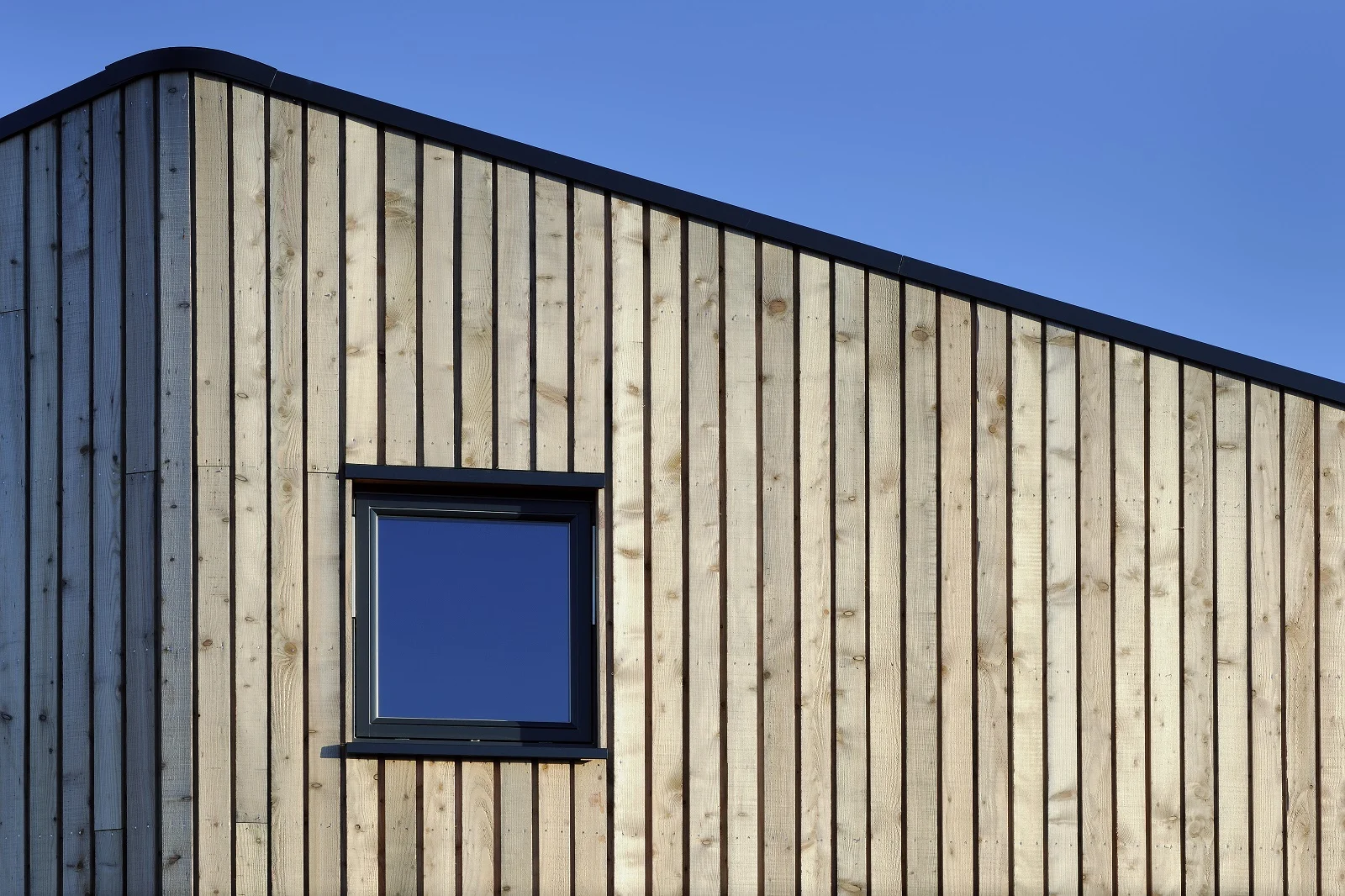
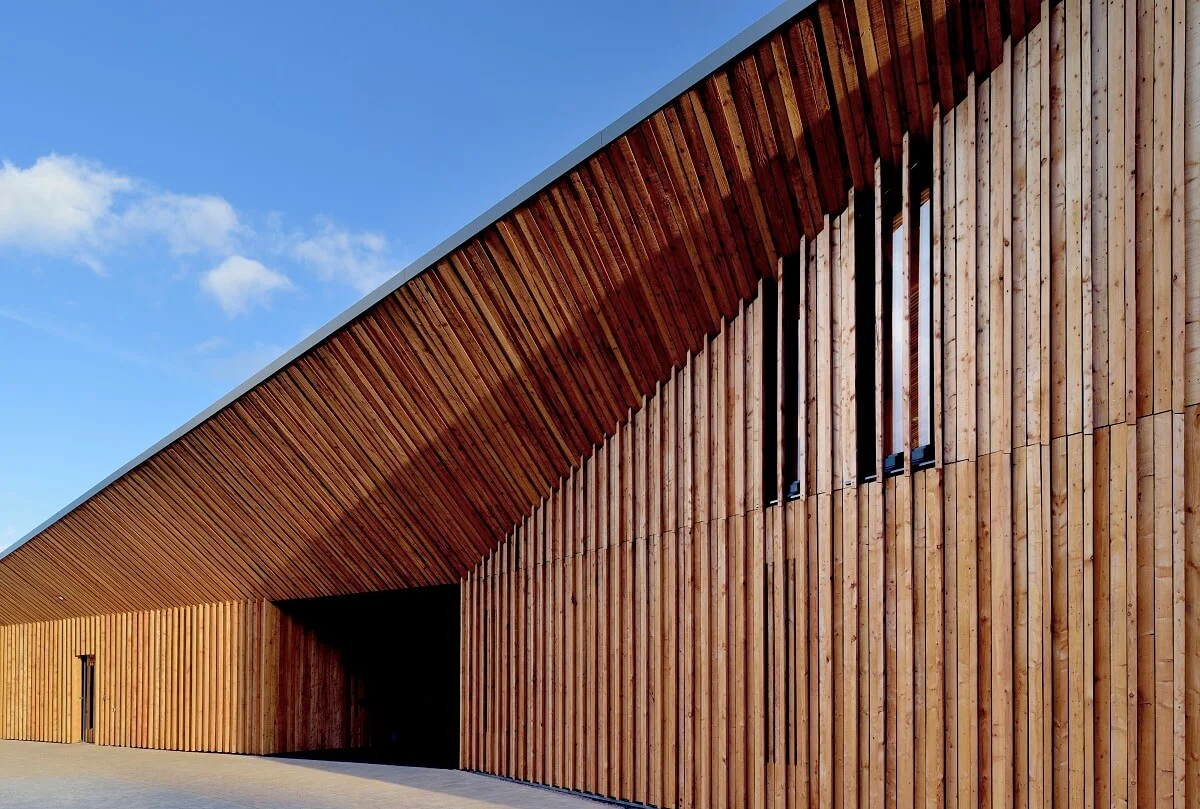
This refers to both the profile and way the cladding is arranged. Open rainscreen cladding (gaps between boards) can only ever achieve a maximum rating of Euroclass E, even with test data. Closed arrangements can range from D to B, depending on the available test data for the specific profile, species, and treatments.
Coatings
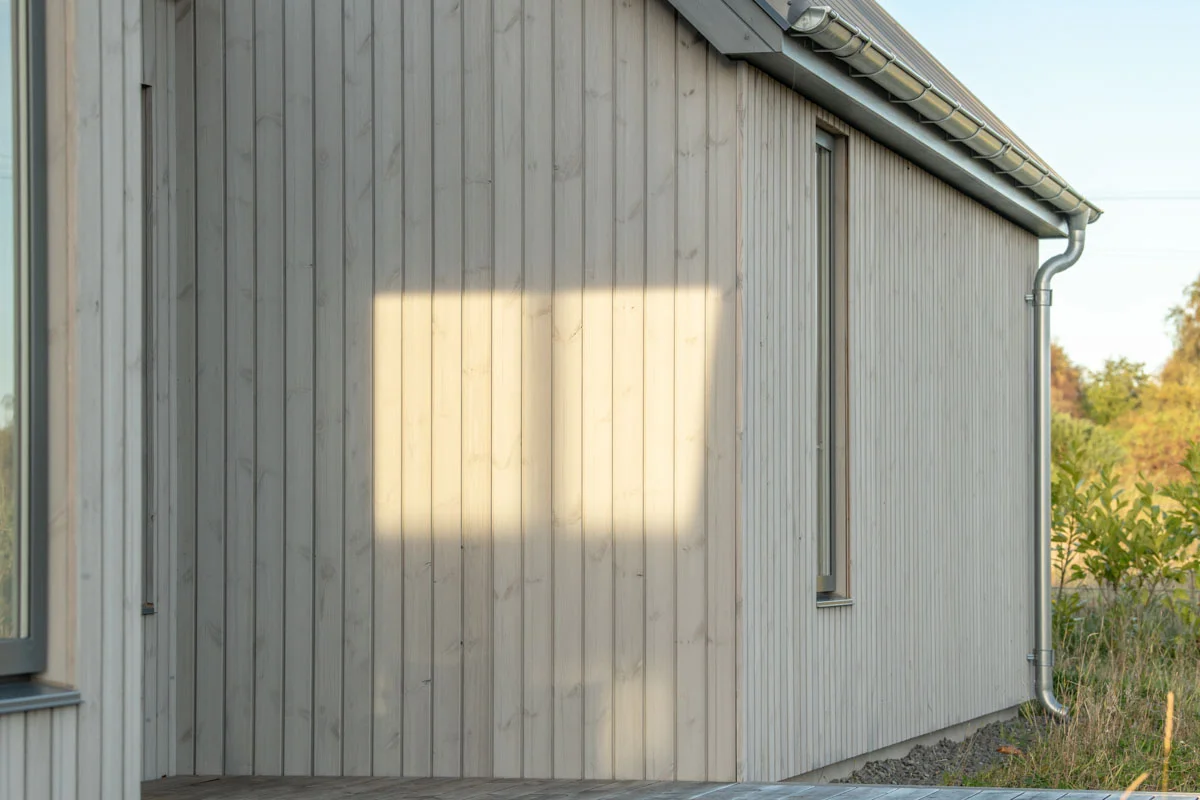
Coatings cannot simply be applied onto cladding that has been treated with a fire retardant with the expectation that the rating will still be valid. Since Euroclass ratings are a test of Surface Spread of Flame, coatings may affect this. For Euroclass F to E, water-based coatings will have no impact on rating. However, for Euroclass D, relevant test data for the coating must be provided to show its impact.
To achieve a Euroclass C/B cladding arrangement, valid fire test data proving that the coating, fire retardant, species and profile used can achieve the stated performance must be provided. Additionally, any coating in addition to fire retardant treatment must be factory-applied in a fully audited process. Fortunately, due to the completion of an extensive fire testing process, Russwood now offers Remmers matte paint coatings, in addition to the SiOO:X Light and Mid Grey coatings, fully certified up to Euroclass B in a select range of profiles and species. This groundbreaking development allows us to offer Burnblock treated cladding in a wider range of colours than ever before, including black, which is one of our most requested Euroclass B coating options.

RW119 profile, factory coated with SiOOX Mid Grey | Galmstrup Architects | Nicholas Kane Photography
Substructure
The choice of substrate material is another factor that will impact your fire rating from Euroclass D to B. The substrate material must be non-combustible (Euroclass A1/A2) for the rating to be valid. This can be achieved through the use of blockwork, cementitious board, etc.
Species and thickness
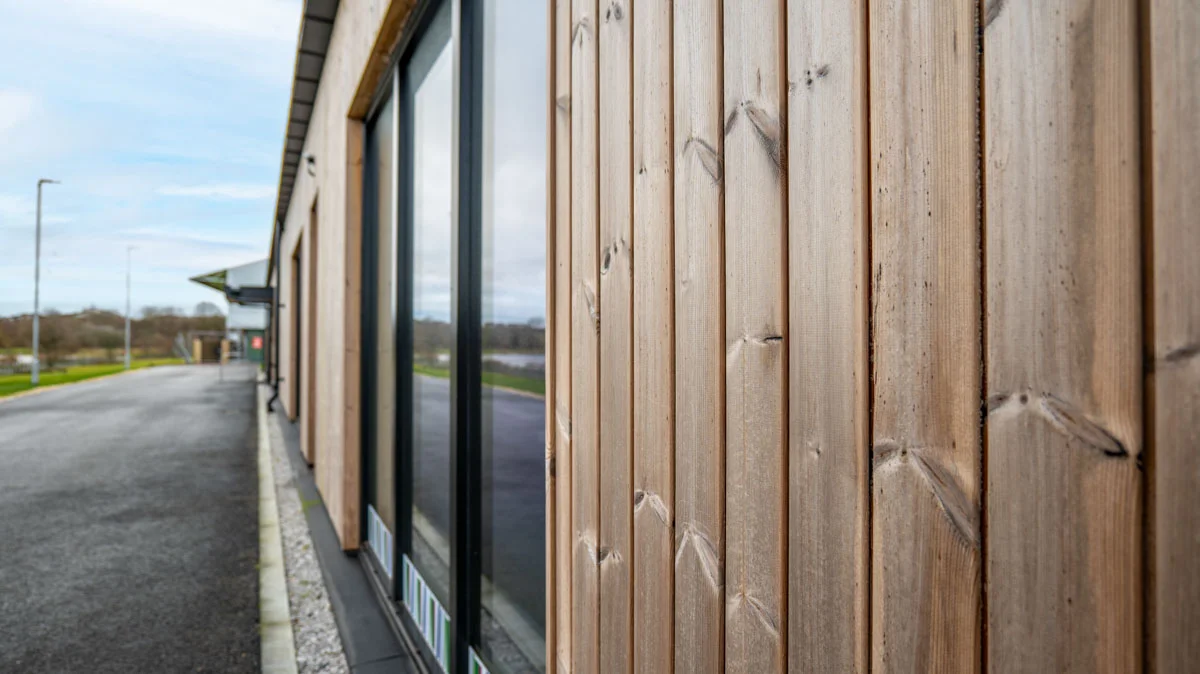
The chosen species will also significantly impact on fire performance due to its natural characteristics. For instance, all cladding used from Euroclass D to B must have a density of 390kg/m3 or higher, and any boards used must be at least 18mm thick.
Fire retardants and test data
The use of fire retardants is required to reach Euroclass C/B, but applying these treatments does not guarantee Euroclass B on open rainscreen cladding, for example, if treated. Fire retardant test data is extremely stringent, and cladding profiles and species that have been tested must be used.
We also recommend using pressure-impregnated fire retardant such as Burnblock®, over on-site applied coatings, as these do not permeate deeply enough into the wood to provide long-term protection. Furthermore, since the application is not uniform, there is no guarantee on performance. We have also seen a recent crackdown on these coatings from Building Control due to the issues highlighted above.
Specifying timber cladding with fire performance requirements
When specifying timber cladding for a project, it is important to confirm the fire performance requirements as early as possible to ensure the chosen cladding is suitable for use. Guidance on this early in the project lifecycle can be primarily found in local building regulations, such as the Scottish Technical Handbook (Scotland) or Approved Document B (England & Wales).
While these regulations may provide early guidance, some local councils may have additional criteria that impact the fire rating. It is advisable to communicate with your local Building Control or Fire Engineer as soon as possible.
Once the Euroclass rating for your project has been confirmed, we can discuss the suitable options for your project. We will be able to best guide you to a workable solution with full certification being provided for Building Control.
Fire safety is an essential aspect of any construction project, particularly when using materials like timber cladding. By understanding the key fire performance requirements and how different factors can influence the Euroclass rating, you can make informed decisions that ensure both safety and design integrity.
Ready to specify timber cladding with confidence?
Reach out to our Specification team today for expert advice and guidance on achieving the right fire performance for your project. Let us help you create safe and beautiful spaces with timber cladding that meets all necessary fire regulations.