A guide to understanding timber movement, stability and cutting techniques

To achieve long-lasting performance from timber cladding, understanding how the material behaves is just as important as selecting the right product. Timber naturally responds to its environment, meaning factors such as moisture, temperature and installation detailing all play a role in how it performs over time. By understanding how timber grows, how it is cut, and how these factors influence stability, designers and specifiers can make more informed decisions and achieve better long-term results.
Understanding timber growth – what is early/late wood?
Timber is a natural material that offers both sustainability and a unique aesthetic. However, to specify it successfully, it’s important to understand how it grows, how it moves, and how different cutting techniques influence performance over time.
Timber has a cellular structure that develops in growth increments, commonly referred to as growth rings. While often associated with the age of the tree in years, these rings more accurately reflect seasonal growth cycles. While it’s often assumed that each ring represents one year of growth, this is not always the case. Growth patterns can vary depending on environmental conditions such as climate and water availability, meaning rings are better understood as indicators of growing conditions rather than precise measures of age.
During warmer growing periods, early wood is formed. At this stage, nutrients and moisture are readily available, resulting in more open wood fibres, a lighter colour, and a less dense structure. In contrast, late wood forms later in the cycle as growth slows. These darker, denser bands provide strength, as the fibres close to protect the tree.
As the tree grows, it expands radially and vertically, with these alternating bands forming to provide both efficient nutrient transport and the structural strength required to support increasing height and load of the tree.
How growth rings influence performance
When timber is used for cladding, growth rings create distinctive grain patterns across the surface. While these are often valued for their visual character, they also play a key role in how the material moves and performs over time.
In traditional milling, timber is typically cut using one of two methods: flat-sawn or quarter-sawn. Each produces different grain patterns and, importantly, different performance characteristics.
Flat-sawn boards are cut tangentially to the growth rings, producing the characteristic curved grain pattern visible on the board ends. While the cut passes across the log, the pith is typically excluded from usable boards due to its instability. The orientation of these growth rings can also guide installation. Boards are generally fixed heart-side out (with the growth rings curving away from the building) as heartwood is typically more durable than sapwood, so this orientation can support improved long-term performance.
Our Scotlarch® is a brilliant option for this, offering up to 150mm nominal sizes with deeper profiles for added resistance to movement.
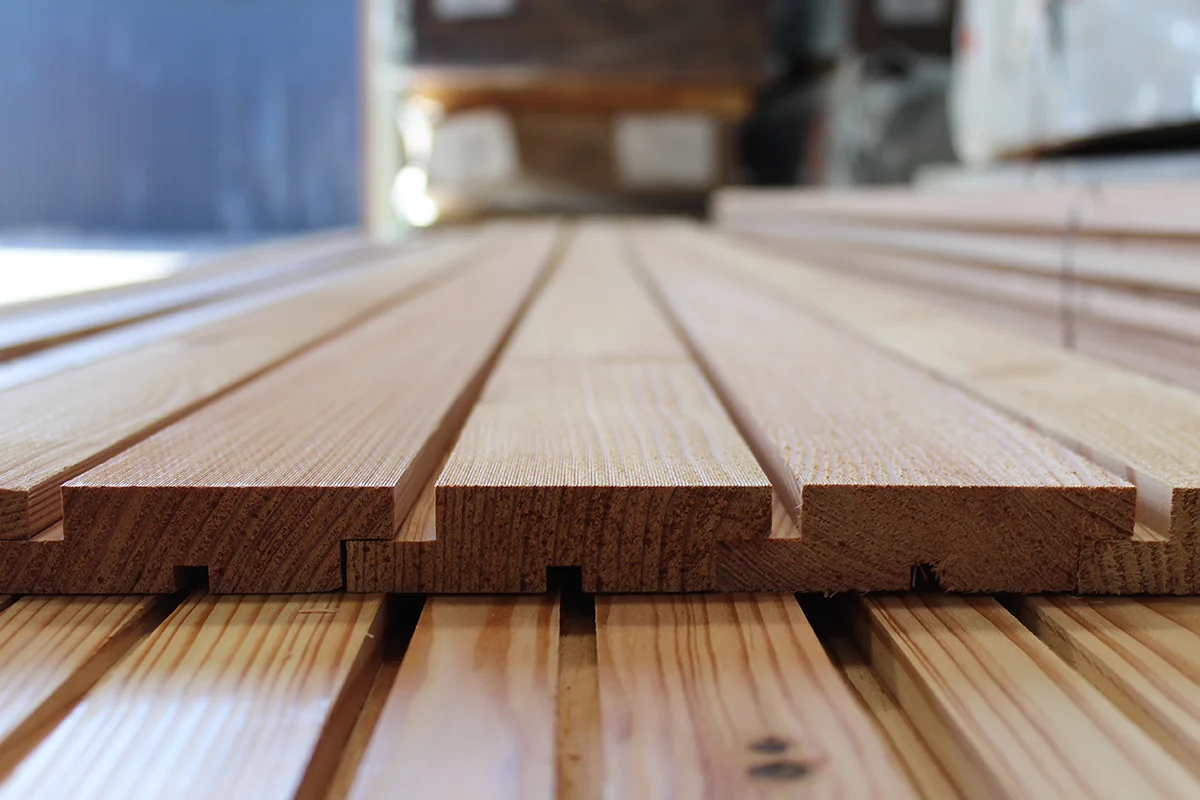
Quarter-sawn boards, on the other hand, are cut radially towards the pith of the log, resulting in a predominantly vertical or near-vertical wood grain along the length of the board. This means the growth rings are cut at approximately 60–90 degrees, producing a straighter, more linear grain pattern. On the end grain, this is also visible as tighter, more uniform lines running across the shorter face of the board.
Our Architect Select® Larch, is an unmodified option of this cutting method. These smaller boards offer a semi-vertical grain with fewer knots.

Cutting methods and stability
Both sawing methods aim to maximise yield from the log, but they result in distinct visual and performance characteristics:
- Flat-sawn boards allow for wider sections and more efficient use of the log. This method produces the characteristic “flame” figuring across the face of the board but also results in greater tangential movement. For this reason, we typically supply deeper sections (at least 22mm) to help resist distortion.
- Quarter-sawn boards offer improved dimensional stability, as the grain runs more vertically through the section. This reduces the likelihood of cupping or distortion over time, while creating a cleaner, more linear aesthetic.
Choosing between these options depends on both the design intent and the performance requirements of the project.
Timber movement in practice
Timber stability is closely linked to its cellular structure. The early wood within each growth ring is more porous and reactive to moisture, meaning it expands and contracts more readily than the denser late wood.
Once boards are cut from the log, the natural curvature of the growth rings creates internal stresses. As the timber responds to changes in moisture, it will attempt to straighten, resulting in movement.
Flat-sawn boards are often best suited to open rainscreen or board-on-board applications, where thicker sections are used, and slight movement can be accommodated.
Quarter-sawn boards, with their more vertical grain orientation, offer improved stability. This makes them better suited to slimmer profiles and applications such as half-lap cladding, where a consistent, directional appearance is important.
However, without modification, some movement can still occur, meaning they are not always ideal for full tongue and groove applications where tight interlocking is required. Instead, we offer half lap profiles where the tongue is not fully enclosed by the next board.
Modified timber solutions for enhanced stability
For projects where stability is a key consideration, modified timber products can offer additional reassurance.
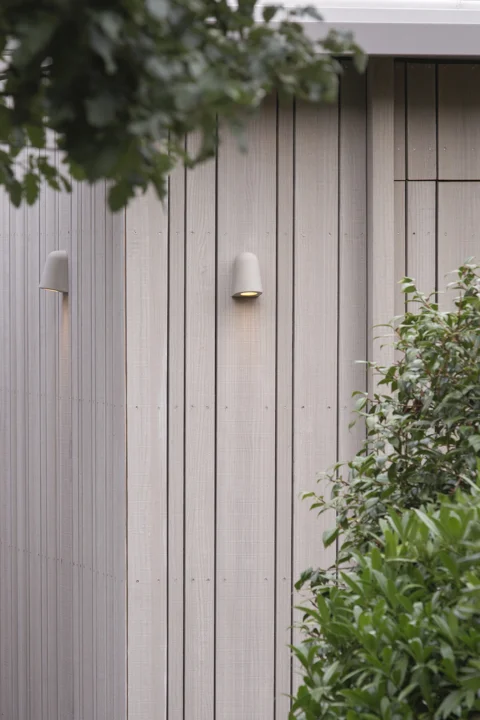
Products such as Abodo® Vulcan Vertical Grain combine vertical grain orientation with thermal modification and lamination. Abodo VG is also laminated from multiple sections, effectively balancing internal stresses. As individual lamellae respond to moisture, opposing grain orientations help counteract movement, resulting in a more stable overall board. This allows for even wider boards of up to 180mm, as well as larger fins and greater flexibility in made-to-order sizing.
Although timber can be modified to enhance performance through thermal or chemical treatment, the way it is cut – and the resulting grain orientation – remains a fundamental factor influencing both appearance and long-term behaviour.
Striking the balance between aesthetics and performance
Understanding how timber grows, moves and responds to its environment is key to making confident specification decisions. While different cutting methods offer distinct visual and performance benefits, correct detailing and installation remain just as important in achieving long-term results.
By considering both the natural characteristics of timber and the specific requirements of your project, it is possible to strike the right balance between aesthetics and performance.
If you’re unsure which option is best suited to your application, our expert team can provide tailored guidance to help you achieve the best possible outcome.
Are you looking to specify timber in your next project?
Our sustainably sourced cladding, decking, and flooring ranges provide high-performance solutions with proven testing behind them. Get in touch to discuss sustainable timber options for your design